Love this? Save it for later!
Share the inspiration with your friends
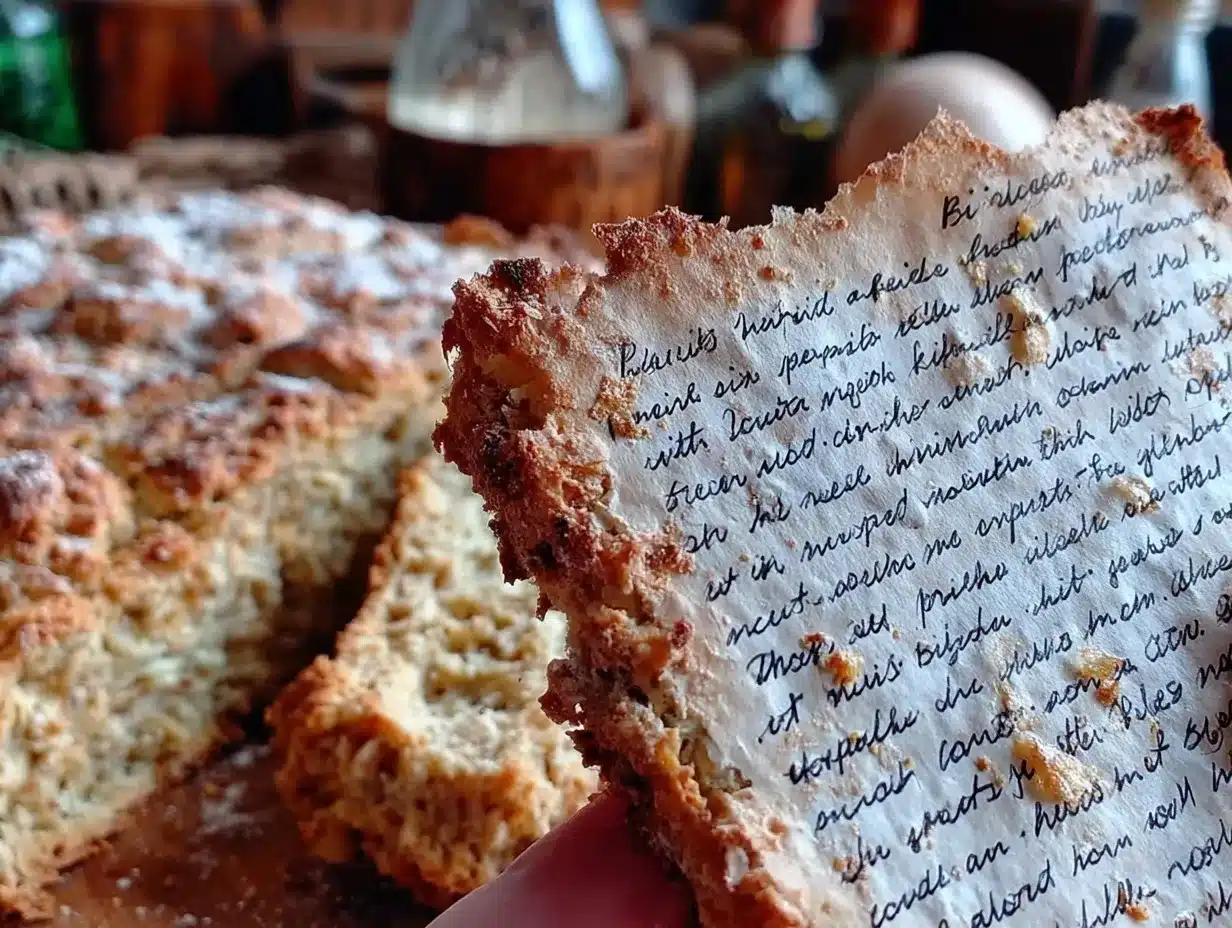
“I found this recipe tucked inside an old book at a local thrift shop—handwritten on a faded, creased card that looked like it had traveled decades through countless kitchen counters. It wasn’t signed, just titled ‘Irish Soda Bread,’ but the messy scrawl and smudged flour marks made it feel like a secret passed down quietly between generations.”
The first time I tried making this cozy Irish soda bread, I honestly had no grand expectations. I mean, soda bread isn’t fancy, right? But something about that little card, the way the instructions were written like a casual conversation, made me want to give it a shot. The smell that filled my kitchen as it baked was like a warm hug on a rainy weekend afternoon. Maybe you’ve been there—staring at a simple recipe with a little skepticism, only to be completely won over by the comforting taste that follows.
This recipe isn’t just about ingredients mixed and baked; it’s a humble, heartwarming story that reached me through that handwritten card. No fancy techniques, just good flour, buttermilk, and a bit of baking soda magic that creates the perfect crust and crumb. It’s the kind of bread that you break apart with your hands, share with friends, and remember years later. Let me tell you, this cozy Irish soda bread recipe has become a staple in my kitchen, one I keep coming back to, especially when the weather turns chilly or when I want to bring a little old-world charm to my table.
Why You’ll Love This Recipe
- Quick & Easy: Comes together in under 45 minutes, perfect for busy mornings or spontaneous baking urges.
- Simple Ingredients: Uses pantry staples you probably already have—no need for exotic stores or specialty ingredients.
- Perfect for Cozy Gatherings: Ideal for breakfast, brunch, or accompanying a hearty Irish stew on a cold day.
- Crowd-Pleaser: This traditional recipe wins over both kids and adults with its tender crumb and golden crust.
- Unbelievably Delicious: The slight tang from buttermilk combined with the subtle sweetness of brown sugar creates a comforting flavor balance.
This isn’t just another Irish soda bread recipe floating around the internet. What sets it apart is the balance between a crunchy crust and soft interior that comes from a little family trick—adding a pinch of caraway seeds and a touch of brown sugar for just the right hint of warmth. Plus, the handwritten card I discovered hinted at loosely mixing the dough by hand, which honestly gives it a rustic, homemade feel you just can’t replicate with a mixer.
Whether you’re new to baking bread or a seasoned pro, this Irish soda bread recipe gives you that old-fashioned, cozy kitchen vibe with minimal fuss. It’s comfort food that brings people together—and that’s why it’s stuck with me all these years.
What Ingredients You Will Need
This recipe uses simple, wholesome ingredients to deliver bold flavor and satisfying texture without the fuss. Most of these are pantry staples, and substitutions are easy if needed.
- All-purpose flour (4 cups / 480g) – The base of the bread; I prefer unbleached for a better texture.
- Baking soda (1 teaspoon) – The leavening agent that gives soda bread its rise.
- Baking powder (1 teaspoon) – Adds a gentle lift for a lighter crumb.
- Salt (1 teaspoon) – Balances the flavors perfectly.
- Brown sugar (2 tablespoons) – Adds a subtle sweetness and depth (I like light brown sugar for its mild molasses flavor).
- Caraway seeds (1 tablespoon, optional) – Traditional touch that adds a warm, slightly licorice flavor.
- Buttermilk (1¾ cups / 420ml) – Gives the bread tenderness and a slight tang; if you don’t have buttermilk, mix regular milk with 1 tablespoon lemon juice and let it sit for 5 minutes.
- Unsalted butter (3 tablespoons, melted) – Adds richness and softness.
For best results, pick fresh baking soda and powder, as stale leavening can cause dense bread. I often grab my buttermilk from the local dairy aisle or make my own, which works just as well. If you’re looking for a dairy-free version, swap buttermilk with coconut yogurt thinned with water—it changes the flavor slightly but keeps the texture nice.
Equipment Needed
- Mixing bowl: A large, sturdy bowl to combine your dry and wet ingredients comfortably.
- Measuring cups and spoons: For precise ingredient amounts (I recommend using both US and metric measurements for accuracy).
- Wooden spoon or spatula: Ideal for gently mixing the dough without overworking it.
- Baking sheet or cast-iron skillet: Either works great; I prefer a cast-iron skillet for a crispier bottom crust.
- Kitchen towel or plastic wrap: To cover the dough while it rests.
- Cooling rack: Helps the bread cool evenly and maintain its crust.
If you don’t have a cast-iron skillet, no worries—just line your baking sheet with parchment paper to prevent sticking. Trust me, I’ve baked this bread straight on a cookie sheet and it still turns out great. For maintenance, keep your cast iron seasoned and clean for the best crust development every time!
Preparation Method
- Preheat your oven to 425°F (220°C). This high temperature is key to a golden, crunchy crust.
- Mix dry ingredients: In a large bowl, whisk together 4 cups (480g) all-purpose flour, 1 teaspoon baking soda, 1 teaspoon baking powder, 1 teaspoon salt, 2 tablespoons brown sugar, and 1 tablespoon caraway seeds (if using). Make sure everything is evenly combined.
- Add melted butter: Pour 3 tablespoons melted unsalted butter into the dry mix. Use your fingers or a spatula to distribute it lightly through the flour mixture—this adds a tender crumb.
- Pour in buttermilk: Slowly add 1¾ cups (420ml) buttermilk, stirring gently with a wooden spoon or spatula. The dough will be sticky and shaggy—that’s exactly how it should be.
- Bring dough together: Use your hands to gently knead the dough in the bowl just until it forms a rough ball. Don’t over-knead; a few folds and turns (about 6-8) are enough. Overworking will make the bread tough.
- Shape the loaf: Turn the dough out onto a lightly floured surface. Shape it into a round loaf about 7 inches (18cm) wide and 2½ inches (6cm) tall. Transfer it to a greased baking sheet or cast-iron skillet.
- Score the top: Use a sharp knife to cut a deep “X” across the top of the dough—about 1/2 inch (1.3cm) deep. This helps the bread expand and gives it that classic look.
- Bake: Place the bread in the oven and bake for 30-35 minutes. The crust should be golden brown, and the loaf should sound hollow when tapped on the bottom.
- Cool: Transfer the bread to a cooling rack and let it rest for at least 15 minutes before slicing. This step lets the crumb set perfectly.
Pro tip: If you notice the crust browning too fast, loosely tent the bread with foil after 20 minutes to prevent burning. And hey, I once forgot to score the loaf and ended up with a rustic, cracked top—still tasted amazing but looked a little wild!
Cooking Tips & Techniques
Making Irish soda bread is straightforward, but a few tricks can make all the difference. Remember, the dough should be sticky and a bit rough—don’t try to make it smooth like traditional yeast bread dough. Over-kneading is the biggest mistake; it results in dense, tough bread.
Use fresh baking soda and powder because old leavening agents won’t give you that lovely rise. When measuring flour, spoon it lightly into your cup and level it off rather than scooping directly from the bag—this avoids packing in too much flour, which can dry out your bread.
Baking in a cast-iron skillet really ups the crust game by distributing heat evenly and creating a beautiful golden bottom. If you’re multitasking, prep your ingredients the night before—just keep the dry mix separate from the wet, then combine when ready. This saves time and reduces kitchen chaos.
When scoring the dough, use a very sharp knife or a bread lame if you have one. It helps the bread expand properly and creates that signature rustic look. Plus, don’t skip the cooling step—cutting too soon can make the crumb gummy.
Variations & Adaptations
- Gluten-Free Version: Substitute the all-purpose flour with a gluten-free blend and add 1 teaspoon xanthan gum for structure. Keep the rest of the ingredients the same.
- Sweet Irish Soda Bread: Add ½ cup (75g) raisins or currants and increase brown sugar to ¼ cup (50g) for a delightful treat perfect with tea.
- Herb-Infused: Mix in 1 tablespoon chopped fresh rosemary or thyme for a savory twist that pairs beautifully with soups.
- Buttermilk Substitute: Use plain yogurt thinned with a splash of water or milk if you don’t have buttermilk on hand.
One personal favorite is adding a handful of chopped walnuts and a sprinkle of cinnamon for a cozy, nutty version that’s perfect for fall mornings. I’ve also baked this bread in muffin tins for quick individual servings that are great for lunchboxes or picnics.
Serving & Storage Suggestions
Serve this Irish soda bread warm or at room temperature—honestly, it’s delicious either way. Slather it with butter and a drizzle of honey, or alongside a bowl of hearty Irish stew for a comforting meal. It’s especially wonderful with sharp cheddar or smoked salmon if you’re feeling fancy.
Store leftover bread wrapped tightly in plastic wrap or in an airtight container at room temperature for up to 2 days. To keep it longer, slice and freeze in a zip-top bag for up to 3 months. Toast slices straight from the freezer for an easy, quick snack.
Reheating in a 350°F (175°C) oven for 10 minutes refreshes the crust nicely. Flavors tend to develop over 24 hours, making the bread even tastier the next day. Just don’t expect it to last long once it’s out—this bread disappears fast in my house!
Nutritional Information & Benefits
Per slice (assuming 10 slices per loaf): approximately 180 calories, 5g fat, 30g carbohydrates, 3g protein.
This recipe provides a good source of energy with simple ingredients. The buttermilk adds calcium and probiotics, which aid digestion. Using brown sugar instead of white adds a touch of minerals like iron and potassium.
It’s naturally free from eggs and nuts (unless you add them), making it suitable for many dietary needs. For gluten-free adaptations, be sure to check your flour blends for allergen information.
As someone who enjoys wholesome comfort foods, this bread strikes a nice balance between tradition and nutrition—simple, satisfying, and grounded in everyday ingredients.
Conclusion
This Irish soda bread recipe from a cherished, handwritten card is a reminder that sometimes the simplest things become our favorites. It’s quick, straightforward, and packed with cozy, comforting flavors that bring a little bit of Ireland right to your kitchen. I love how it turns the ordinary act of baking into a moment worth savoring.
Feel free to tweak it to your liking—add seeds, swap flours, or turn it sweet or savory. The beauty is in its versatility and warmth. If you give it a try, I’d love to hear how you made it your own, so drop a comment below or share your photos. Happy baking, and may your kitchen be filled with that golden, crusty goodness!
FAQs
What makes Irish soda bread different from regular bread?
Irish soda bread uses baking soda and buttermilk for leavening instead of yeast, which makes it quicker to make and gives it a dense but tender crumb.
Can I use regular milk instead of buttermilk?
You can substitute by mixing 1 tablespoon lemon juice or vinegar with 1¾ cups milk and letting it sit for 5 minutes to mimic buttermilk’s acidity.
Why is it important to score the dough before baking?
Scoring allows the bread to expand evenly while baking and creates the classic rustic “X” look on top.
How should I store leftover Irish soda bread?
Wrap it tightly and keep at room temperature for 2 days or freeze sliced portions for longer storage.
Can I add other ingredients like seeds or dried fruit?
Absolutely! Caraway seeds are traditional, but raisins, currants, nuts, or herbs make delicious variations to suit your taste.
By the way, if you enjoy traditional breads with a twist, you might also appreciate the crispy garlic chicken recipe or the comforting hearty Irish stew that pairs beautifully with this soda bread. Both dishes bring a little extra soul to your table.
Pin This Recipe!
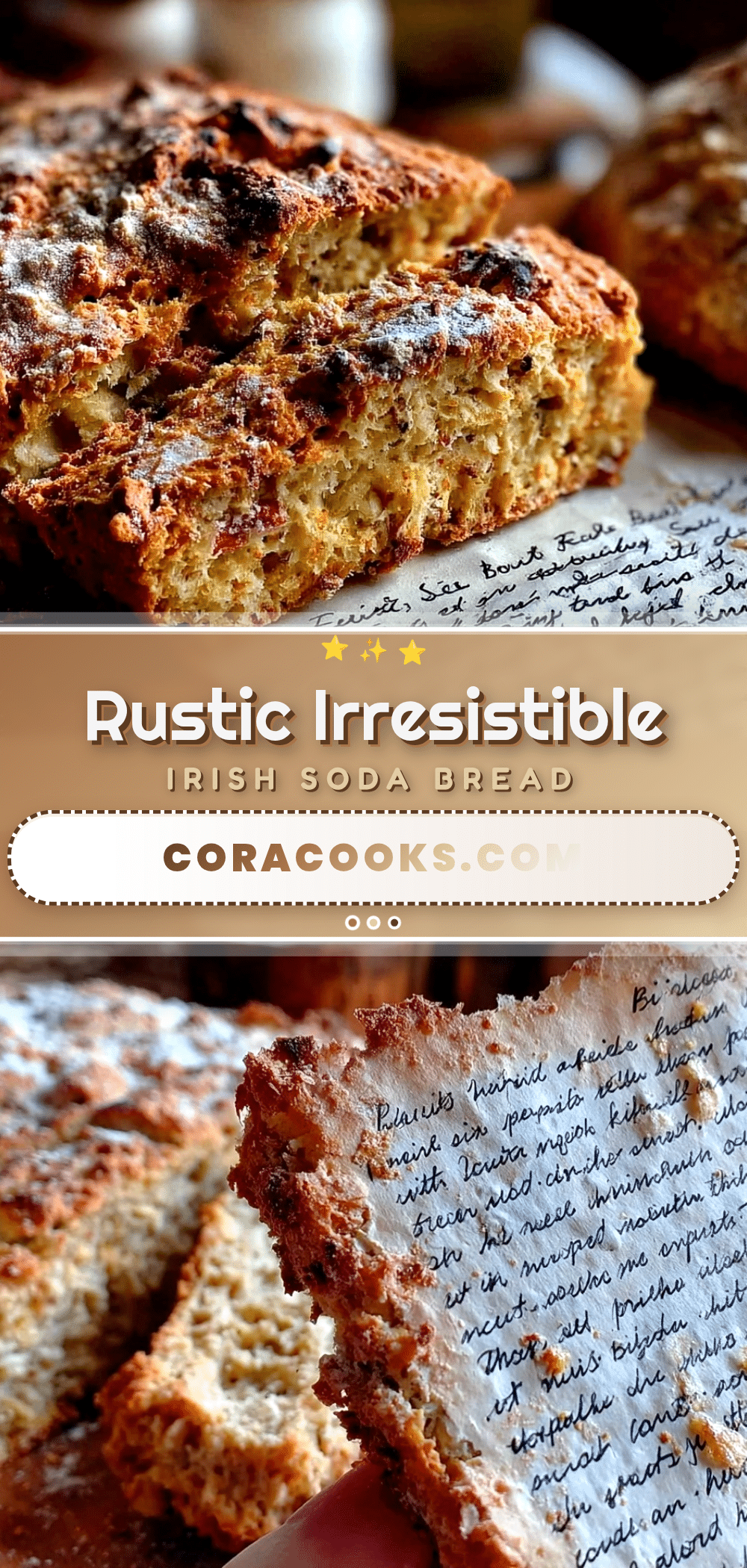
Irish Soda Bread Recipe Easy Homemade Cozy Traditional Family Favorite
A cozy, traditional Irish soda bread recipe featuring a crunchy crust and tender crumb, made with simple pantry ingredients and a touch of brown sugar and caraway seeds for warmth.
- Prep Time: 10 minutes
- Cook Time: 30-35 minutes
- Total Time: 45 minutes
- Yield: 10 servings 1x
- Category: Bread
- Cuisine: Irish
Ingredients
- 4 cups (480g) all-purpose flour
- 1 teaspoon baking soda
- 1 teaspoon baking powder
- 1 teaspoon salt
- 2 tablespoons brown sugar
- 1 tablespoon caraway seeds (optional)
- 1¾ cups (420ml) buttermilk
- 3 tablespoons unsalted butter, melted
Instructions
- Preheat your oven to 425°F (220°C).
- In a large bowl, whisk together flour, baking soda, baking powder, salt, brown sugar, and caraway seeds (if using).
- Pour melted butter into the dry mix and lightly distribute it through the flour mixture using fingers or a spatula.
- Slowly add buttermilk, stirring gently with a wooden spoon or spatula until dough is sticky and shaggy.
- Gently knead the dough in the bowl just until it forms a rough ball, about 6-8 folds and turns. Do not over-knead.
- Turn dough onto a lightly floured surface and shape into a round loaf about 7 inches wide and 2½ inches tall.
- Transfer loaf to a greased baking sheet or cast-iron skillet.
- Score a deep ‘X’ about ½ inch deep across the top of the dough.
- Bake for 30-35 minutes until crust is golden brown and loaf sounds hollow when tapped on the bottom.
- Cool on a rack for at least 15 minutes before slicing.
Notes
Use fresh baking soda and baking powder for best rise. Do not over-knead the dough to avoid tough bread. Score the dough before baking to allow expansion. Tent with foil if crust browns too quickly. Cool completely before slicing to prevent gummy crumb.
Nutrition
- Serving Size: 1 slice (assuming 10
- Calories: 180
- Fat: 5
- Carbohydrates: 30
- Protein: 3
Keywords: Irish soda bread, traditional bread, quick bread, homemade bread, buttermilk bread, easy bread recipe, cozy bread