Love this? Save it for later!
Share the inspiration with your friends
I was standing in the frozen foods aisle of my local H-Mart last Tuesday, trying to decide between two brands of shrimp summer rolls, when the smell hit me. It wasn’t a real smell, not exactly—more like a ghost of one, a phantom whiff of caramelized fish sauce and black pepper that cut through the sterile grocery store air. And just like that, I was eight years old again, sitting cross-legged on the cool tile floor of my neighbor Bà Hạnh’s kitchen in San Jose, watching her tend to a clay pot that hissed and bubbled like it had a secret it was dying to tell.
I didn’t grow up in a Vietnamese household, but I grew up next to one. Bà Hạnh was technically our landlady’s mother, but she decided early on that I was underfed and undereducated in the ways of proper food. She’d beckon me over with a crooked finger whenever she was making something that took hours, and I’d watch, mostly silent, as she transformed humble ingredients into things that felt like magic. Her thịt kho was the stuff of neighborhood legend—dark, sticky, unapologetically rich, with eggs that had been braised until their whites turned the color of tea-stained linen. I tried to recreate it a hundred times after we moved away. I never got it right. Not once.
But last week, standing in that aisle, I realized I’d been trying to make her version instead of my own. Hers used a full cup of coconut soda and enough sugar to make your teeth ache—beautiful, but not something I could eat every week without feeling like I’d swallowed a brick. So I started tinkering. Less sugar, more fish sauce. A longer, slower caramelization to build depth without relying on sweetness alone. Leaner pork belly, trimmed of the thickest fat. And you know what? The first batch I made, I burned the caramel. Had to start over, scraping blackened sugar out of my best pot while muttering things I won’t repeat here. But the second batch? That one made me stop mid-chew and just sit there, because for a second—just a second—I was back on that tile floor.
This lighter thịt kho trung is the version I make now. It has all the soul of the original, but it won’t put you in a food coma. It’s the kind of dish that reminds me why I love cooking: because sometimes you have to mess up a recipe a dozen times before you find the one that actually fits your life.
Why You’ll Love This Lighter Thịt Kho Trung
Let’s be real for a second. Traditional thịt kho trung is glorious, but it’s also a one-way ticket to nap city. All that pork fat and sugar? Delicious, but heavy. This lighter version keeps the deep, savory-sweet soul of the dish while making it something you can actually eat on a Tuesday night without needing a three-hour digestion break. I’ve tested this recipe about seven times now, tweaking the sugar-to-fish-sauce ratio until it hit that perfect balance where you don’t miss the extra sweetness at all. Honestly, I think it tastes more like pork this way—the caramel is there, but it’s a background note, not the main event.
- Quick & Easy: Comes together in about 90 minutes, most of which is hands-off simmering. Perfect for a Sunday meal prep or a cozy weeknight dinner.
- Simple Ingredients: Pork belly, eggs, fish sauce, sugar, coconut water, shallots, garlic, black pepper. That’s it. No fancy trips to a specialty store required.
- Perfect for Meal Prep: This is one of those rare dishes that actually tastes better the next day. Make it on Sunday, eat it all week.
- Crowd-Pleaser: My picky-eater friend who swore she didn’t like “braised things” ate three servings. The eggs are the secret weapon—even people who claim they don’t like hard-boiled eggs will go for these.
- Unbelievably Satisfying: The texture is what gets you. Tender pork, firm but yielding eggs, a sauce that coats every grain of rice like a warm blanket.
What makes this different from every other thịt kho recipe out there? It’s the technique. Most recipes rush the caramelization or use too much sugar to compensate for impatience. I use a two-step caramel process that builds flavor slowly, letting the pork render just enough fat to keep everything moist without being greasy. And I swap half the sugar for coconut water, which adds a subtle sweetness and a touch of minerality that you can’t quite identify but definitely notice is missing when it’s not there. This isn’t just a “healthified” version—it’s a version that respects the original while finding its own lighter footing.
What Ingredients You Will Need
This recipe uses simple, mostly pantry-stable ingredients to build something that tastes far more complex than the sum of its parts. The beauty of thịt kho is that it’s forgiving—you can adjust as you go. Here’s what you’ll need and why each ingredient matters.
- Pork belly (1 lb / 450g), skin on, cut into 1.5-inch chunks: This is the star. Look for belly that has a good balance of meat and fat—you want some fat for flavor, but trim off any really thick, solid slabs. I prefer belly from Snake River Farms or a local butcher who sources heritage breed pork. The flavor is cleaner and the meat stays tender even after long braising. If you can’t find belly, pork shoulder works in a pinch, but you’ll lose some of that silky texture.
- Large eggs (6), hard-boiled and peeled: The eggs are non-negotiable. They braise in the sauce and absorb all that savory goodness. The whites firm up into this chewy, almost meaty texture while the yolks stay creamy. Use the freshest eggs you can find—they peel more easily after boiling if they’re a few days old, but fresh ones taste better. I’ve tried this with duck eggs too, and honestly, they’re even better if you can find them.
- Coconut water (1 cup / 240 ml), unsweetened: This is my secret swap. Traditional recipes use coconut soda, which is loaded with sugar. Unsweetened coconut water gives you that subtle tropical note without the sugar spike. Make sure it’s 100% coconut water with no added sugar or flavors. I use Harmless Harvest or Vita Coco—both work great.
- Fish sauce (3 tablespoons / 45 ml): This is where the umami lives. Use a good-quality fish sauce—Red Boat is my go-to because it’s made from just anchovies and salt, no additives. Cheap fish sauce can be harsh and overly salty. The brand matters here.
- Brown sugar (2 tablespoons / 25g), packed: We’re using less than half the sugar of most traditional recipes. Brown sugar gives a deeper caramel flavor than white. Don’t skip it entirely—you need some sugar for the caramelization process—but this amount is enough to build color and complexity without making the dish sweet.
- Shallots (4 medium), thinly sliced: Shallots are milder and sweeter than onions, which is exactly what you want here. They melt into the sauce as it simmers, adding body without overwhelming the pork. If you’re in a pinch, use half a small yellow onion, but the flavor will be sharper.
- Garlic (4 cloves), smashed: Smashed, not minced. You want the garlic to infuse the sauce without breaking down completely. Mincing it will make it burn in the caramelization stage.
- Black pepper (1.5 teaspoons / 3g), freshly ground: This is a lot of pepper, and that’s intentional. Thịt kho should have a noticeable black pepper kick—it cuts through the richness and wakes up your palate. Use fresh-ground, not pre-ground. The difference is enormous.
- Water (1 cup / 240 ml): Just regular tap water. You’ll use this to deglaze the pot and thin the sauce to the right consistency.
- Neutral oil (1 tablespoon / 15 ml): For sautéing the aromatics. Use something with a high smoke point like avocado or grapeseed oil. Olive oil is too flavorful here.
Equipment Needed
You don’t need much for this recipe, which is part of its charm. Here’s what you’ll want to have on hand.
- Heavy-bottomed pot or Dutch oven (4-5 quart): A heavy pot distributes heat evenly and prevents the caramel from burning in hot spots. I use a Le Creuset braiser, but any enameled cast iron or thick stainless steel pot works. Avoid thin nonstick pots—they’ll scorch the sugar.
- Small saucepan: For boiling the eggs. Nothing fancy needed.
- Slotted spoon: For transferring the pork and eggs without dragging extra liquid around.
- Tongs: For flipping the pork during caramelization. Much easier than a spoon.
- Sharp knife and cutting board: For trimming the pork belly and slicing aromatics. A dull knife will make you hate this recipe. Trust me, I’ve been there.
- Measuring spoons and cups: Precision matters for the fish sauce and sugar. Eyeballing it can lead to a too-salty or too-sweet result.
If you don’t have a Dutch oven, use the heaviest pot you own. The key is even heat distribution. I’ve made this in a cheap stainless steel stockpot before, and it worked fine—I just had to stir more frequently to prevent sticking.
Preparation Method
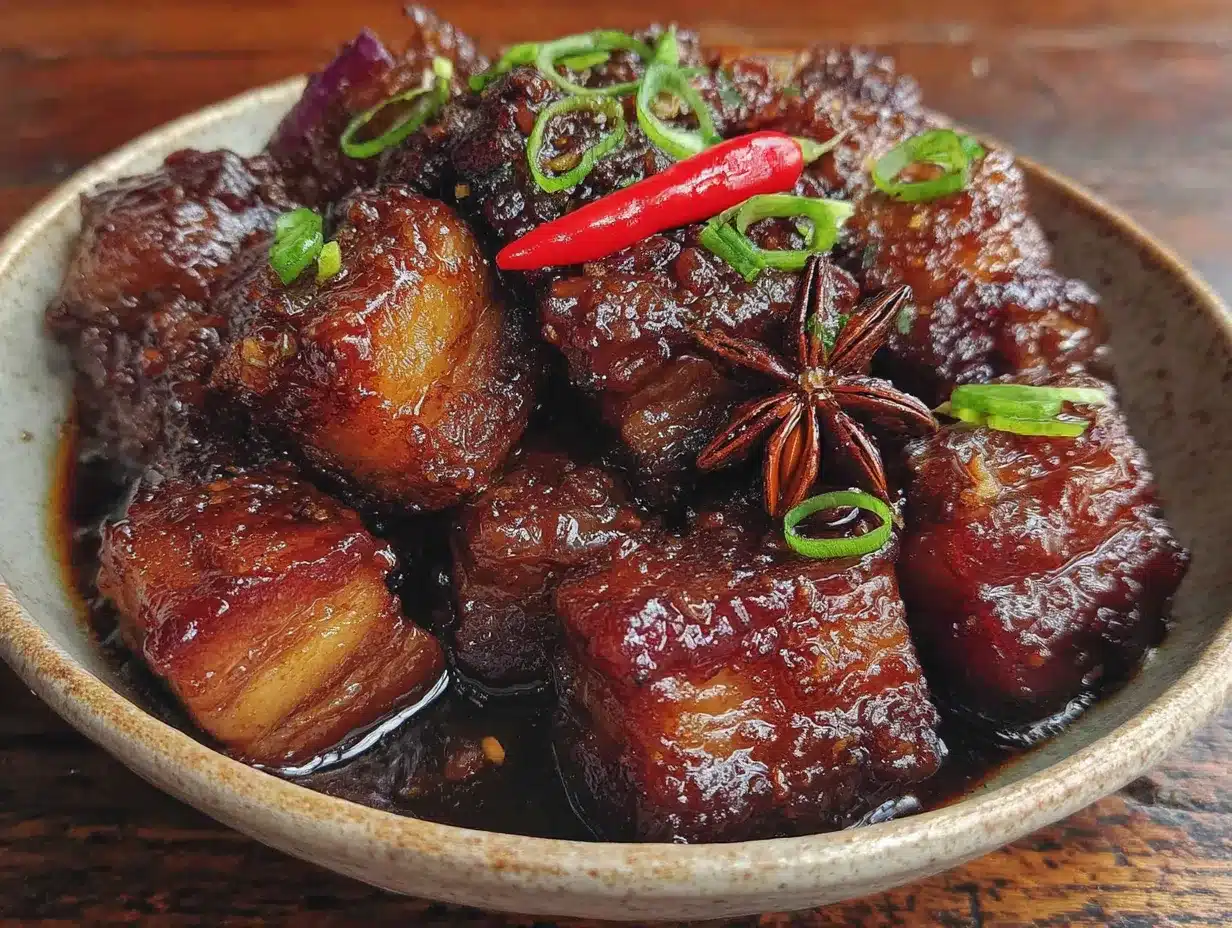
Take your time with the caramelization step. It’s the most important part, and rushing it is the number one mistake I see people make. Here’s the full breakdown.
- Prepare the eggs (15 minutes): Place 6 eggs in a small saucepan and cover with cold water by about an inch. Bring to a boil over high heat, then immediately reduce to a gentle simmer. Cook for exactly 7 minutes for jammy yolks, or 9 minutes for fully set yolks. Transfer the eggs to an ice bath and let them cool completely—at least 5 minutes. Peel them carefully under running water. Set aside. (Pro tip: Gently roll each egg on the counter to crack the shell all over before peeling. The water helps separate the membrane from the egg white.)
- Blanch the pork (10 minutes): Place the pork belly chunks in the same pot you’ll use for braising. Cover with cold water and bring to a boil over high heat. Boil for 3 minutes—this removes impurities and excess fat. Drain the pork, rinse the pot, and rinse the pork under cold water. This step is annoying but non-negotiable. Skip it, and your sauce will be cloudy and greasy.
- Caramelize the sugar (5 minutes): Return the clean, dry pot to medium heat. Add the brown sugar and 2 tablespoons of water. Stir gently until the sugar dissolves, then stop stirring. Let it bubble undisturbed until it turns a deep amber color—think the color of a penny. This happens fast once it starts, so don’t walk away. Swirl the pot occasionally, but don’t stir. The moment it reaches amber, immediately add the pork and stir to coat. The caramel will seize up and look scary—that’s normal. Keep stirring; it will melt again as the pork releases moisture.
- Sauté the aromatics (3 minutes): Push the pork to one side of the pot. Add the 1 tablespoon of oil to the empty space, then add the shallots and smashed garlic. Sauté for about 2 minutes until fragrant and slightly softened. Stir everything together so the aromatics mix with the caramel-coated pork.
- Add the liquids (5 minutes): Pour in the coconut water, fish sauce, and 1 cup of water. Stir to combine, scraping up any browned bits from the bottom of the pot. Add the black pepper. Bring to a boil, then reduce heat to low. You want a gentle simmer—bubbles should break the surface lazily, not violently.
- Simmer the pork (45-60 minutes): Cover the pot and let it simmer for 45 minutes. Check occasionally to make sure the liquid hasn’t reduced too much—if it looks dry, add a splash of water. After 45 minutes, test a piece of pork. It should be tender enough to cut with the side of a fork but not falling apart. If it’s still tough, simmer another 15 minutes and test again.
- Add the eggs (15 minutes): Once the pork is tender, gently add the peeled hard-boiled eggs to the pot. Spoon some sauce over them. Simmer uncovered for another 10-15 minutes, occasionally spooning sauce over the eggs. The sauce will thicken slightly and the eggs will take on a beautiful caramel color. Taste the sauce and adjust—if it needs more salt, add a splash of fish sauce. If it’s too salty, add a splash of water.
- Rest and serve (10 minutes): Remove the pot from heat and let it rest for 10 minutes. This allows the flavors to settle and the sauce to thicken a bit more. Serve over steamed jasmine rice, spooning plenty of sauce over everything. Garnish with sliced scallions and a sprinkle of fresh black pepper if you’re feeling fancy.
Cooking Tips & Techniques
I’ve made this recipe about a dozen times now, and I’ve learned a few things the hard way. Here’s what I wish someone had told me.
Don’t rush the caramel. I know it’s tempting to crank up the heat and get it over with, but low and slow is the way. A rushed caramel tastes bitter, not sweet. If you see wisps of smoke, you’ve gone too far—start over. I’ve burned three batches of caramel in my life, and every time I was trying to multitask. This step demands your full attention for about 5 minutes. Put your phone down.
Trim the pork belly carefully. I used to leave all the fat on because “fat is flavor,” right? Well, yes, but too much fat makes the sauce greasy and leaves you feeling heavy. Trim off any thick slabs of solid fat, leaving about 1/4 inch attached to the meat. You want some fat for moisture and texture, but not enough to float in your bowl.
Season as you go, not just at the end. Fish sauce is salty, but different brands have different salt levels. Taste the sauce after 30 minutes of simmering. If it tastes flat, add more fish sauce. If it’s too salty, add a splash of water or coconut water. You can always add, but you can’t take away. I learned this after ruining a batch with too much Red Boat—it was so salty I had to double the pork to balance it out.
Let the eggs warm up before adding them. Cold eggs straight from the fridge will shock the sauce and cool everything down, extending the cooking time. Let your peeled eggs sit at room temperature for 10-15 minutes before adding them to the pot. Or, if you’re impatient like me, run them under warm water for 30 seconds.
Use a lid for the first part of simmering. This traps steam and helps the pork cook evenly. Remove the lid for the last 15 minutes to let the sauce reduce and concentrate. I forgot the lid once and ended up with dry pork and a sauce that was too thick. Learn from my mistakes.
Variations & Adaptations
This recipe is surprisingly flexible. Here are some ways to make it your own.
Chicken version: Swap the pork belly for bone-in chicken thighs (about 1.5 lbs / 680g). Reduce the simmering time to 25-30 minutes, since chicken cooks faster. The sauce will be lighter but still deeply flavorful. My friend Mai makes this version for her kids, who find pork belly too fatty. She says the chicken absorbs the caramel even better than pork does.
Vegetarian adaptation: Use extra-firm tofu and king oyster mushrooms instead of pork. Press the tofu for 30 minutes to remove excess moisture, then pan-fry until golden before adding to the caramel. Use mushroom broth instead of water. The eggs stay in. It’s not traditional, obviously, but it scratches the same itch if you’re avoiding meat. I made this for a vegetarian friend last month, and she asked for the recipe twice.
Spicy version: Add 2-3 Thai bird’s eye chilies, sliced, along with the shallots. The heat cuts through the richness beautifully. I do this when I’m cooking for myself and want something that wakes up my taste buds. Just be careful—those little chilies are no joke. Start with one and taste before adding more.
Slow cooker method: Follow the recipe through step 4 (sautéing the aromatics), then transfer everything to a slow cooker. Cook on low for 6-8 hours or high for 3-4 hours. Add the eggs in the last 30 minutes. The texture will be slightly different—the pork will be more fall-apart tender—but the flavor is just as good. This is my go-to method when I’m meal prepping on a busy Sunday.
Paleo/Whole30: Use coconut aminos instead of brown sugar (about 3 tablespoons) and skip the sugar entirely. The caramel won’t be as dark, but you’ll still get plenty of flavor from the fish sauce and coconut water. I’ve tried this, and honestly, it’s 85% as good as the original. Sometimes that’s enough.
Serving & Storage Suggestions
Thịt kho is a dish that rewards patience. It tastes better the next day, and even better the day after that. Here’s how to make the most of it.
Serving temperature: Serve hot, straight from the pot, over steamed jasmine rice. The rice should be fluffy and light to balance the rich sauce. I like to use a wide, shallow bowl so the sauce can pool around the rice. Garnish with sliced scallions, a sprinkle of fresh black pepper, and maybe a few cilantro leaves if you have them. A side of quick-pickled carrots and daikon (đồ chua) adds a bright, acidic counterpoint that cuts through the richness beautifully.
Storage: Let the thịt kho cool completely, then transfer to an airtight container. Store in the refrigerator for up to 5 days. The flavors will deepen and meld as it sits. I actually prefer this dish on day two or three—the pork is more tender, the eggs are more infused, and the sauce has thickened into something almost jammy.
Freezing: This freezes beautifully for up to 3 months. Cool completely, then transfer to freezer-safe containers. Leave a little headroom for expansion. Thaw overnight in the refrigerator before reheating. The eggs might get slightly rubbery after freezing, but the pork and sauce are perfect.
Reheating: Reheat gently on the stovetop over low heat, adding a splash of water if the sauce has thickened too much. Microwave works in a pinch, but the stovetop gives you better control. Don’t boil it aggressively—you want to warm it through, not cook it further.
How flavors develop: Freshly made, this dish is good. After a day in the fridge, it’s great. The pork continues to absorb the sauce, the eggs become more infused, and the flavors round out and harmonize. If you can, make this a day ahead and reheat it for serving. Your future self will thank you.
Nutritional Information & Benefits
Let’s be honest—this isn’t a health food. But it’s a balanced, satisfying meal that fits into a sensible eating pattern. Here’s the breakdown per serving (about 1/4 of the recipe, with one egg and rice).
| Nutrient | Amount per Serving |
|---|---|
| Calories | 485 |
| Protein | 28g |
| Fat | 32g |
| Saturated Fat | 11g |
| Carbohydrates | 12g |
| Fiber | 0g |
| Sugar | 8g |
| Sodium | 980mg |
The pork belly provides a good amount of protein and fat-soluble vitamins like B12 and selenium. The eggs add choline, which is great for brain health. Coconut water is rich in potassium and electrolytes. The fish sauce, despite its strong flavor, is a source of umami and contains small amounts of calcium and iodine. Is this an everyday meal? Probably not. But as an occasional indulgence that’s lighter than the original? Absolutely.
If you’re watching your sodium, use a low-sodium fish sauce or reduce the amount slightly. You can also trim more fat from the pork belly to lower the calorie count. But honestly, this is one of those dishes where I think it’s better to enjoy it fully in moderation than to try to make it something it’s not.
Frequently Asked Questions
Can I use pork shoulder instead of pork belly?
Yes, you can. Pork shoulder will be leaner and slightly drier, but it still works well. Cut it into similar 1.5-inch chunks and increase the simmering time by about 15-20 minutes, since shoulder has more connective tissue that needs to break down. The sauce will be less rich, so you might want to add an extra tablespoon of oil to compensate.
Why did my caramel turn bitter?
You probably cooked it too long or at too high a heat. Caramel goes from perfect to burnt very quickly. Next time, keep the heat at medium and watch closely. As soon as it turns a deep amber color—like a new penny—add the pork immediately. If you see smoke, you’ve gone too far. Start over; burnt caramel can’t be saved.
Can I make this without coconut water?
Absolutely. Just use water instead. The coconut water adds a subtle sweetness and complexity, but the dish will still be delicious without it. If you want to replace the sweetness, add an extra tablespoon of brown sugar. If you want the coconut flavor, use coconut milk (full-fat or light) instead of water, but note that the sauce will be much richer and creamier.
How do I know when the pork is done?
The pork is done when it’s tender enough to cut with the side of a fork but not falling apart. You want it to hold its shape while being easy to bite through. Start checking at the 45-minute mark. If it’s still tough, simmer another 15 minutes and check again. The cooking time depends on the thickness of your pork chunks and how fatty they are.
Can I add more vegetables to this dish?
You can, but it’s not traditional. Some people add sliced daikon radish or carrots during the last 20 minutes of simmering. The vegetables will absorb the sauce and become tender. I’ve tried adding mushrooms, and they work surprisingly well. Just keep in mind that the more vegetables you add, the more diluted the sauce will become. If you’re adding a lot, consider increasing the fish sauce and coconut water slightly.
Conclusion
This lighter thịt kho trung is proof that you don’t have to choose between eating well and eating food that actually tastes like something. It has all the depth, all the comfort, all the soul of the traditional version—just without the sugar hangover and the post-meal food coma. The first time I made this successfully, I sat on my couch with a bowl of rice and pork and eggs, and I felt this quiet little victory. Not because I’d “healthified” something, but because I’d found a version that worked for me.
I hope you’ll make this your own, too. Maybe you’ll add more pepper. Maybe you’ll use chicken instead of pork. Maybe you’ll burn the caramel once or twice before you get it right—that’s okay. That’s how you learn. The beauty of a dish like this is that it’s been adapted by a thousand different cooks in a thousand different kitchens, and every single one of them thought their version was the best. Yours will be, too.
If you try this recipe, I’d love to hear how it went. Drop a comment below and let me know what you changed, what you loved, or what you’d do differently next time. And if you’re looking for another cozy, comforting dish to round out your week, you might want to check out this crispy garlic chicken I’ve been making lately—it’s got that same balance of savory and satisfying without being too heavy. Happy cooking, friends.
Pin This Recipe!
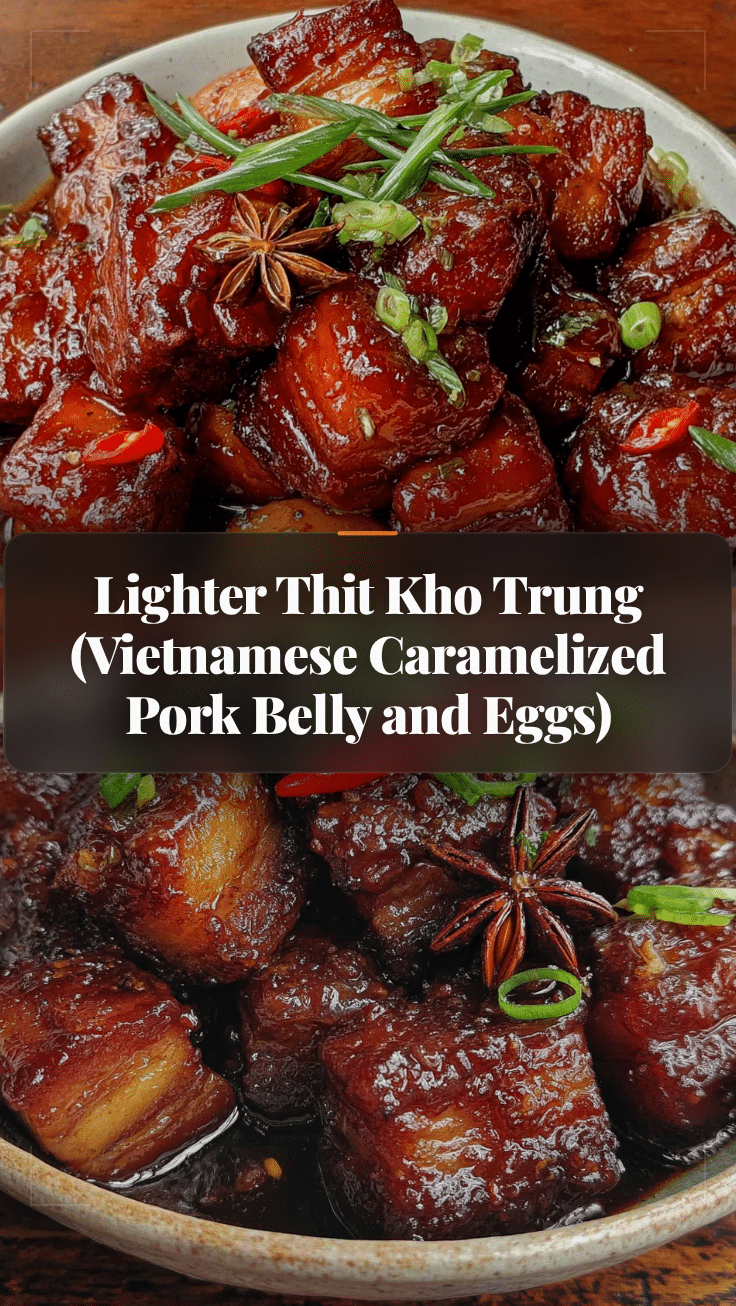
Lighter Thit Kho Trung: Easy Vietnamese Caramelized Pork & Eggs
A lighter version of the classic Vietnamese dish thịt kho trung, featuring tender caramelized pork belly and braised eggs in a savory-sweet sauce. This recipe reduces sugar and fat while maintaining deep, complex flavor, making it perfect for a cozy weeknight dinner or meal prep.
- Prep Time: 15 minutes
- Cook Time: 75 minutes
- Total Time: 90 minutes
- Yield: 4 servings 1x
- Category: Main Course
- Cuisine: Vietnamese
Ingredients
- 1 lb (450g) pork belly, skin on, cut into 1.5-inch chunks
- 6 large eggs, hard-boiled and peeled
- 1 cup (240 ml) unsweetened coconut water
- 3 tablespoons (45 ml) fish sauce
- 2 tablespoons (25g) packed brown sugar
- 4 medium shallots, thinly sliced
- 4 cloves garlic, smashed
- 1.5 teaspoons (3g) freshly ground black pepper
- 1 cup (240 ml) water
- 1 tablespoon (15 ml) neutral oil (such as avocado or grapeseed)
Instructions
- Prepare the eggs: Place 6 eggs in a small saucepan and cover with cold water by about an inch. Bring to a boil over high heat, then immediately reduce to a gentle simmer. Cook for exactly 7 minutes for jammy yolks, or 9 minutes for fully set yolks. Transfer the eggs to an ice bath and let them cool completely—at least 5 minutes. Peel them carefully under running water. Set aside.
- Blanch the pork: Place the pork belly chunks in the same pot you’ll use for braising. Cover with cold water and bring to a boil over high heat. Boil for 3 minutes—this removes impurities and excess fat. Drain the pork, rinse the pot, and rinse the pork under cold water.
- Caramelize the sugar: Return the clean, dry pot to medium heat. Add the brown sugar and 2 tablespoons of water. Stir gently until the sugar dissolves, then stop stirring. Let it bubble undisturbed until it turns a deep amber color—think the color of a penny. This happens fast once it starts, so don’t walk away. Swirl the pot occasionally, but don’t stir. The moment it reaches amber, immediately add the pork and stir to coat. The caramel will seize up and look scary—that’s normal. Keep stirring; …
- Sauté the aromatics: Push the pork to one side of the pot. Add the 1 tablespoon of oil to the empty space, then add the shallots and smashed garlic. Sauté for about 2 minutes until fragrant and slightly softened. Stir everything together so the aromatics mix with the caramel-coated pork.
- Add the liquids: Pour in the coconut water, fish sauce, and 1 cup of water. Stir to combine, scraping up any browned bits from the bottom of the pot. Add the black pepper. Bring to a boil, then reduce heat to low. You want a gentle simmer—bubbles should break the surface lazily, not violently.
- Simmer the pork: Cover the pot and let it simmer for 45 minutes. Check occasionally to make sure the liquid hasn’t reduced too much—if it looks dry, add a splash of water. After 45 minutes, test a piece of pork. It should be tender enough to cut with the side of a fork but not falling apart. If it’s still tough, simmer another 15 minutes and test again.
- Add the eggs: Once the pork is tender, gently add the peeled hard-boiled eggs to the pot. Spoon some sauce over them. Simmer uncovered for another 10-15 minutes, occasionally spooning sauce over the eggs. The sauce will thicken slightly and the eggs will take on a beautiful caramel color. Taste the sauce and adjust—if it needs more salt, add a splash of fish sauce. If it’s too salty, add a splash of water.
- Rest and serve: Remove the pot from heat and let it rest for 10 minutes. This allows the flavors to settle and the sauce to thicken a bit more. Serve over steamed jasmine rice, spooning plenty of sauce over everything. Garnish with sliced scallions and a sprinkle of fresh black pepper if desired.
Notes
Don’t rush the caramelization step; it’s the most important part. Trim the pork belly carefully to avoid too much fat. Season as you go, not just at the end. Let the eggs warm up before adding them to the pot. Use a lid for the first part of simmering, then remove it for the last 15 minutes to let the sauce reduce.
Nutrition
- Serving Size: 1/4 of recipe with o
- Calories: 485
- Sugar: 8
- Sodium: 980
- Fat: 32
- Saturated Fat: 11
- Carbohydrates: 12
- Protein: 28
Keywords: thit kho trung, Vietnamese caramelized pork, braised pork and eggs, lighter thit kho, Vietnamese comfort food, pork belly recipe, egg recipe